Community Contribution #6- Personalization
For the past decade or so I’ve been using an online platform called Ultimate Guitar by Muse Group that has official and community-made chords for songs. The official chords and many other features are behind a paywall, but all of the community-created song chords are free for anyone to use. Having used this site for a considerable time, I have observed numerous updates and accommodations, the most recent of which, introduced about two months ago, is significantly better than the previous one.
When looking through songs, you can look through a few different versions, usually ranging in difficulty, to see which best suits your abilities (see the left tab in the image below). After choosing a version, you can go through the song’s chords and pick the ones that suit you best. In the image below, the tab on the right had the chords; on the first one, you can see the ‘1 of 9,’ which is where you can look through the nine different ways to play that chord. This feature is one of the site’s newest additions. This example of personalization is what Bulger (2016) explained as an adaptive system; the platform allows real-time accommodations for its users to ensure personal success.
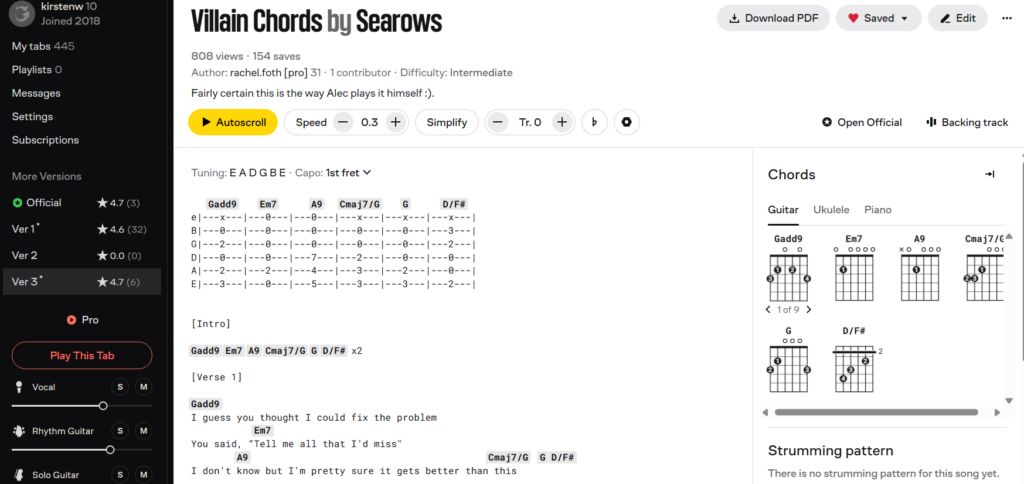
This is currently my favourite song to play because the chords sound just like the song. This tab provides the recommended chords right at the top. Personally, I opt to play the A9 chord like the chords on the right instead because it’s a much easier transition. As a casual guitar player, if I had not been shown an alternative method to play the one chord I struggle with, I likely would not have attempted to play the song at all! These are in line with Kerins’ (2021) motivational fundamental of their self-determination theory, particularly autonomy and competence. Since I was able to change the chords myself, I was given autonomy to then feel like I had what it took to play the song, resulting in competence and the motivation to keep playing the song until I learn it by heart.
References
Bulger, M. (2016). Personalized Learning: The Conversations We’re Not Having. Data & Society Research Institute. https://datasociety.net/wp-content/uploads/2016/09/PersonalizedLearning_primer_2016.pdf
Kerins, T. (2021). Self-Determination Theory. The Decision Lab. https://thedecisionlab.com/es-ES/reference-guide/psychology/self-determination-theory